FigBuild 2026 · Designathon
Linger
Because some moments should linger.
A multi-feature mobile app for scent-mapping, with a speculative wearable concept, designed in 83 hours.
View on Devpost* Some features discussed are speculative and not all are implemented in the prototype. Speculative design was central to the FigBuild 2026 brief by Figma.
UX & UI Design
83 hours to quantify a sense
FigBuild 2026 asked us to quantify a human sense. We picked smell.
We were a team of 4, and 2 of us had never partaken in a designathon. As we brainstormed, we decided that smell was not only intriguing, but also fun to speculate about.
I pushed, consistently, for ideas that could benefit someone in a serious way. For smell, that meant Alzheimer's and dementia: accessing memories through a sense, on command.
Two ideas we scrapped first
Before scent, we had two ambitious concepts on the table.
- Biophilic AR. A speculative space-station UI that would swap sterile surroundings for responsive natural scenery, calibrated to your biophilic response. Scope consumed too many resources. AR was a skill gap, and the problem space was too open.
- A sensory-deprivation cloak. An app-controlled wearable that compresses your sense of time, built around pain and boredom: MRIs for chronic-pain patients, and long boring flights. The team didn't align, and the vision of our app prototype felt lackluster.
We returned to scent. It was feasible in 83 hours, and we had a shared visual excitement about what scent could look like. The use case shifted early: our first instinct was a scanner for identifying someone's perfume, but it didn't feel weighty or useful enough. A niche idea like that was good, but we wanted to use this opportunity to think outside the box. Once we reframed around helping someone with Alzheimer's re-access a memory, the project earned its scope.
A scent app, and the wearable it would need to exist
The app does four things: detect, archive, map, and emit (we consider detection and archiving to be part of 1 feature). A speculative wearable then entered the picture, because we had to emit from somewhere. A brain chip felt too easy (as it could be argued for any project in this designathon). A nose-worn attachment was the most honest delivery mechanism for our concept, it might seem basic, but we wanted it to feel like a product you could easily imagine. Most of our time, though, was spent on the app.
A. Detect
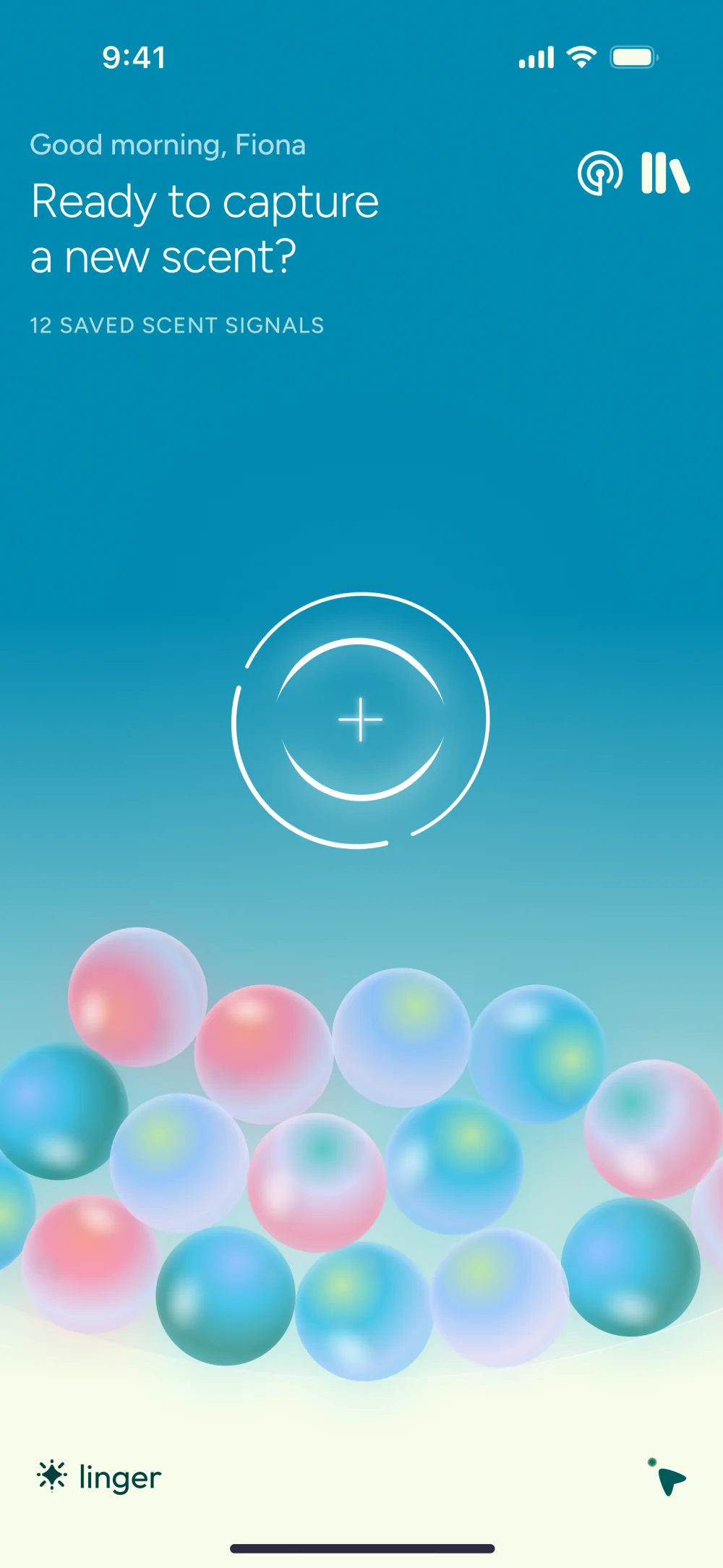
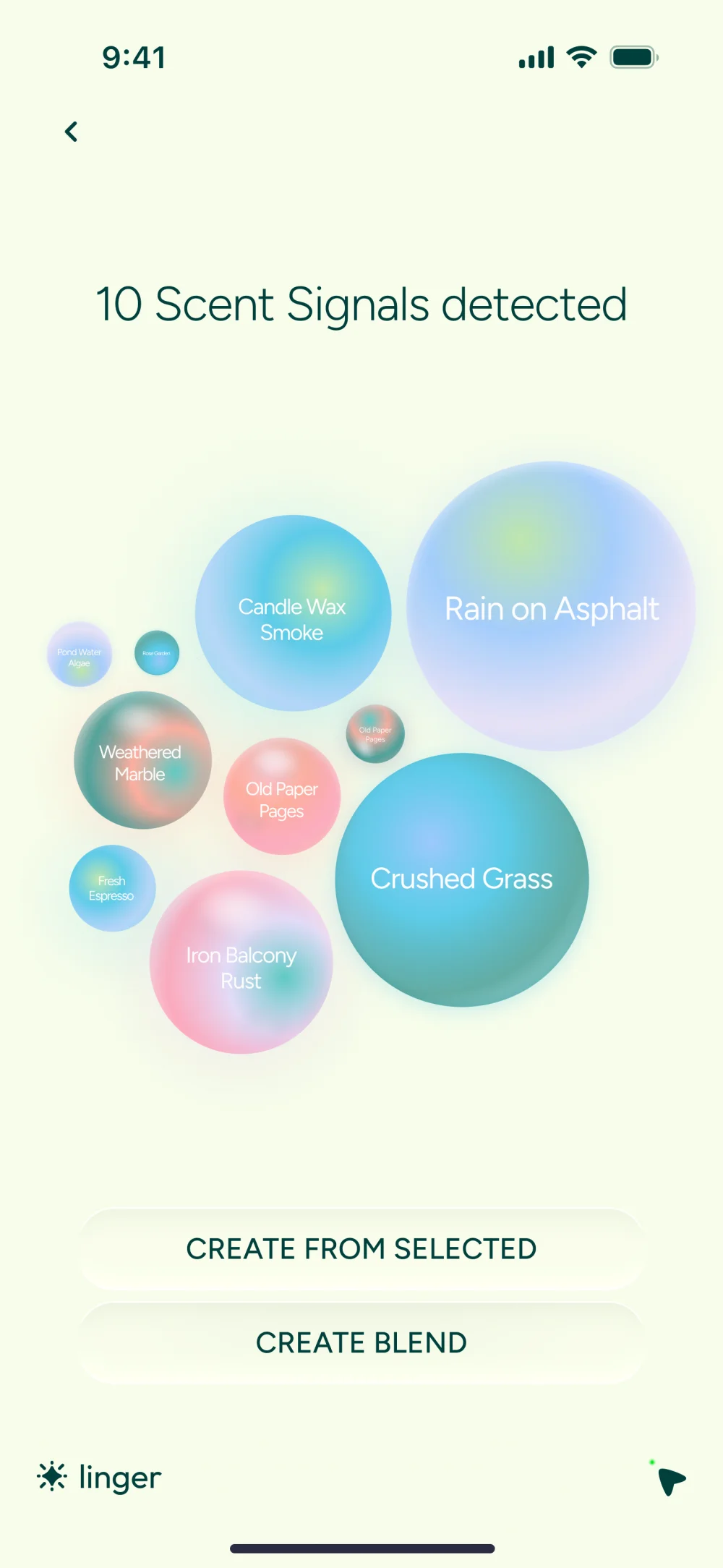
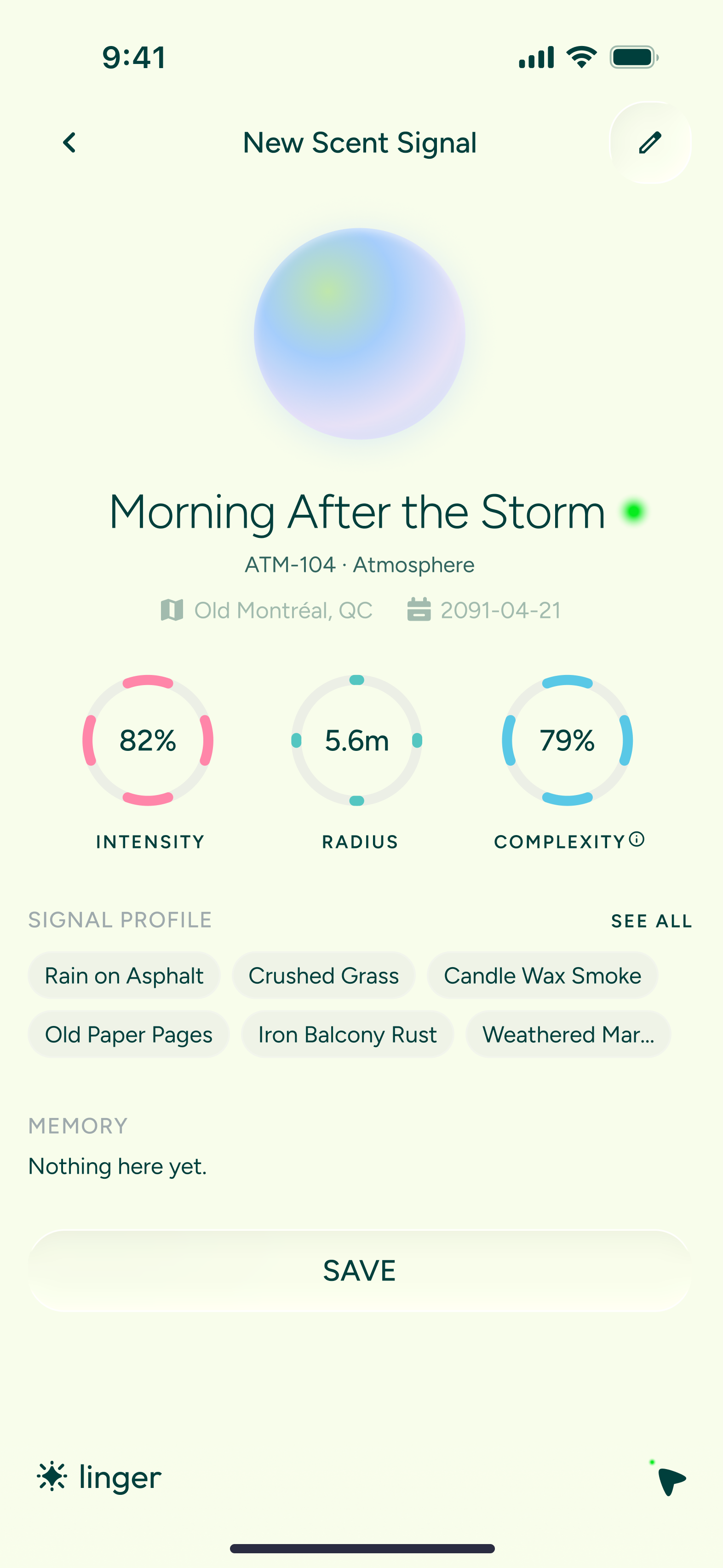
The wearable senses ambient chemical compounds in real-time. Users capture a scent as a "memory signal", represented by an orb whose color reflects its chemical family, and whose texture and vibrancy reflect the state of the moment it was captured (by default, but customizable).
B. Archive
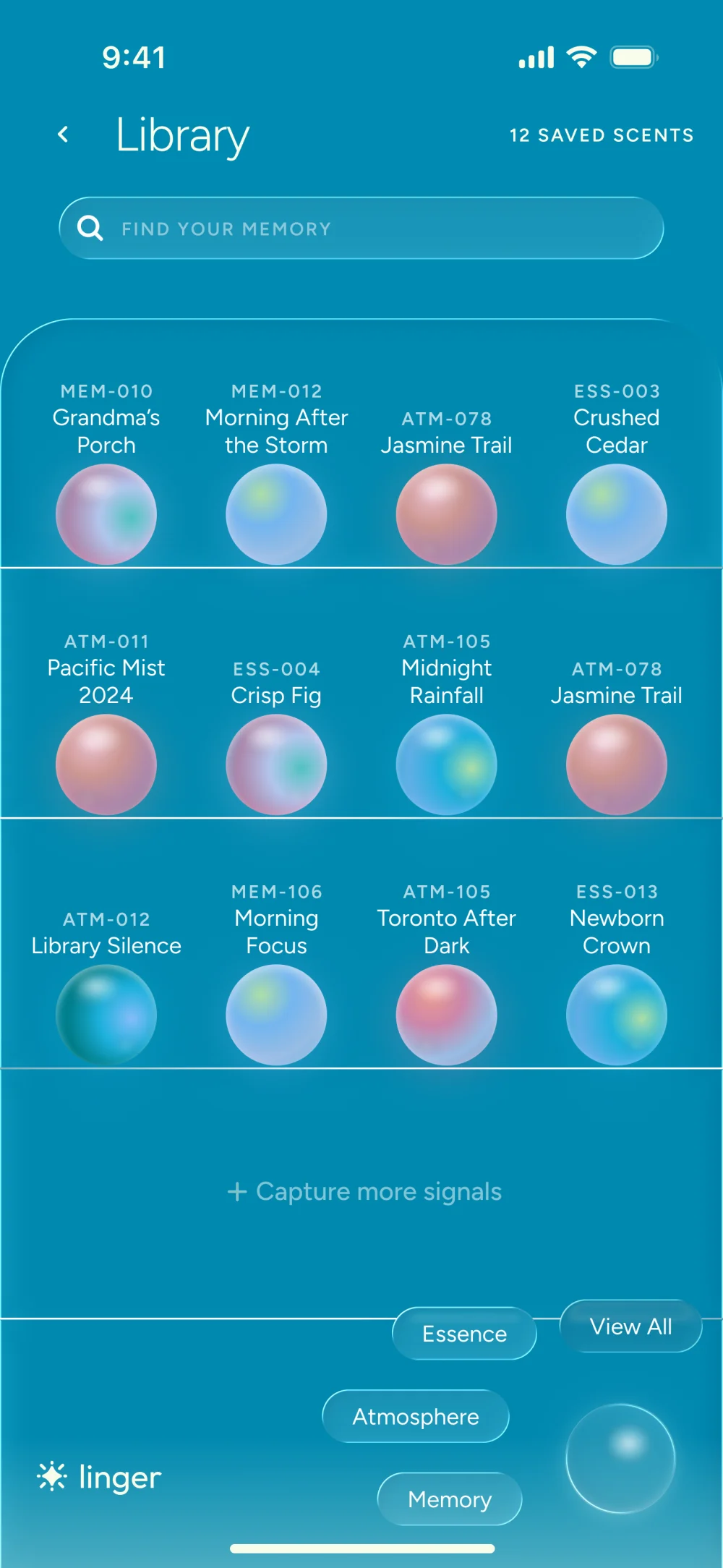
A personal library of olfactory history. Each entry logs date, location, mood, and scent intensity, letting users revisit moments through a non-linear, sensory lens.
C. Map
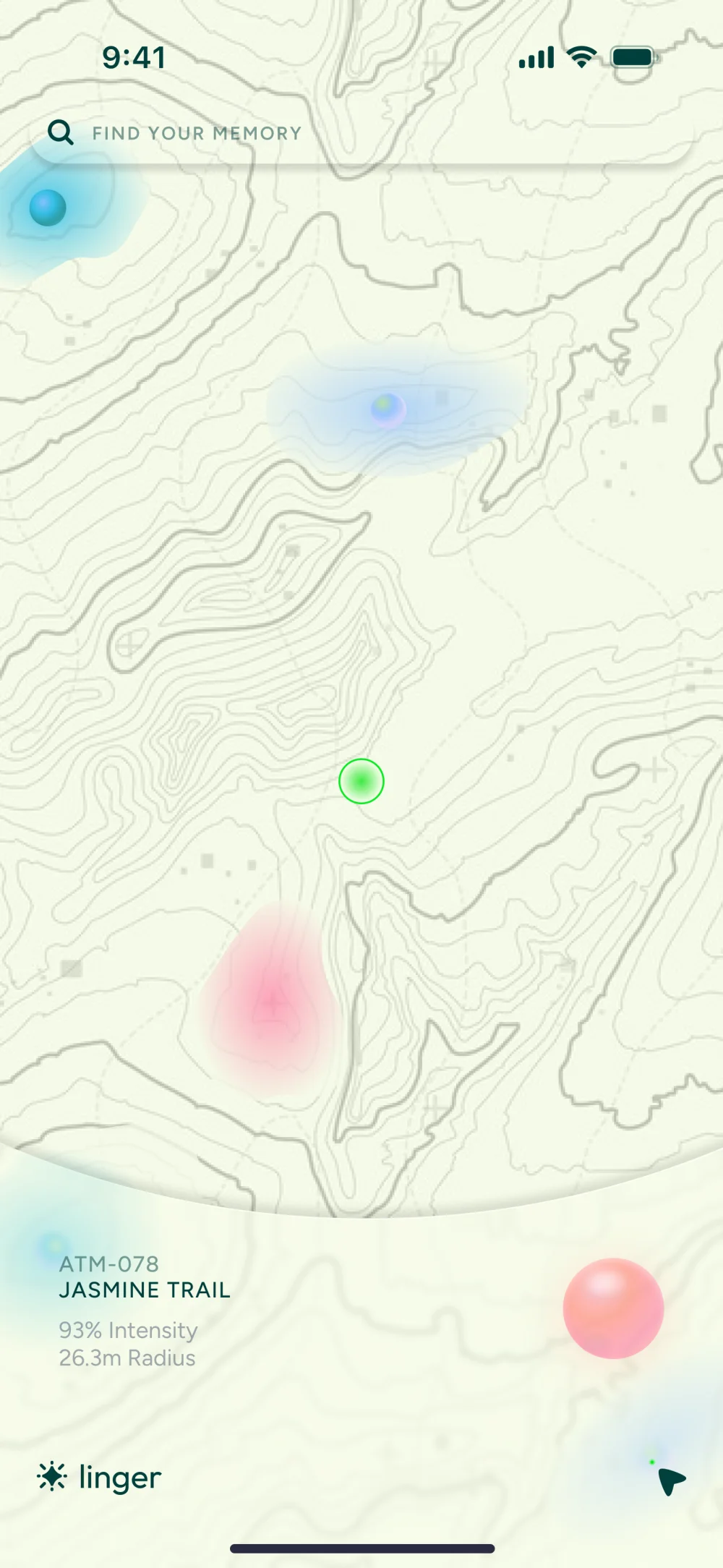
A spatial visualization of the user's scent-scape. View saved signals, discover similar scents in the environment, or follow scent trails through a place.
Orbs as a diegetic interface
Before orbs, we tried perfume-bottles, gradients, and a few other directions. The orbs just felt right to all four of us. We all felt like we knew what they were attempting to portray, through speculation. They stayed customizable in color, they felt abstract enough to hold meaning without prescribing it, and they doubled as a living home screen where favorite scents grow with each scan.
- Vibrancy = scent intensity
- Hue = chemical family
- Diffusion = scent longevity and range
Demo
Interactive Prototype
Select a flow to explore below.
Designing around responsibility
Olfactory data felt deeply personal. When I think of my favorite scent, I feel as if it's a memory that belongs only to me. The brief pushed us to heavily consider this. Four safeguards built into the product:
- Ghost zones: user-defined areas where scent detection is automatically turned off, so others around you aren't quietly being scanned.
- Cognitive-overload prevention: the app caps scent intensity and how many signals surface at once, so users aren't overwhelmed.
- Palette-cleanser: a quick way to clear lingering scents between emissions, so one memory doesn't bleed into the next.
- Ambient-scent filter: a way to block unwanted scents from the environment, so users control what they take in (could be considered an additional feature, in the future).
What 83 hours with a strange sense taught me
Kill ideas faster
Day 1 brainstorming ran long, and we nearly lost our pacing trying to settle on a concept. Next time: hard time caps per phase, everyone's top ideas on the table up front, and someone actively flagging when we're drifting past the deadline.
One question I'd keep workshopping
"Do users need to see the chemistry behind a scent like 'rain on asphalt,' or is naming the orb enough?"
We didn't have time to resolve this. The app shows both, and neither felt fully right. Honest answer: I don't know yet.
What I'd push for next time
- Animation fidelity: the orb-float behavior we prototyped and cut.
- Tool evaluation: we tried Figma Make. At our scale, building the prototype manually was faster and more controllable.
- Usability testing: not possible in 83 hours, but this product needs it before any serious next step.
Tools used
- Figma: UI design, prototyping, and components.
- FigJam: collaborative ideation.
- Google Gemini: brainstorming and concept acceleration.